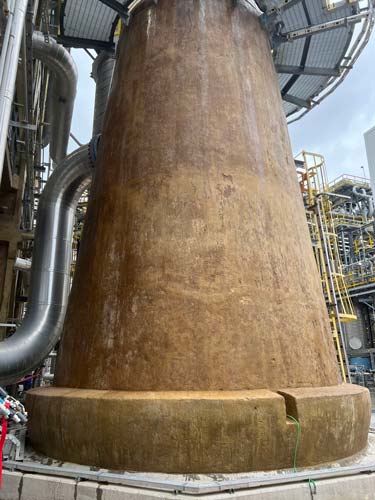
New Advances in Cementitious Fireproofing: Learn More at AMPP 2025
Join Art MacKinnon, an leading expert in industrial fireproofing, at the AMPP Annual Confe...
Read more

One of the most costly challenges in the petrochemical industry today is managing corrosion under insulation(CUI) and corrosion under fireproofing (CUF). The most simplistic description of corrosion on steel is rust.
The vast majority of steel corrosion consists of an electro-chemical reaction converting the iron into an oxide. This type of corrosion is most typically prevented or controlled with the use of coatings, galvanizing, or grounding.
The second-largest type of steel corrosion is from chemical attack. This type of corrosion can be prevented or controlled with the use of coatings.
NACE (National Association of Corrosion Engineers) estimated in NACE International News, March 8, 2016, that the “global cost of corrosion at $2.5 trillion annually.” For some countries, this is a significant portion of their GDP.
Energy Skeptic reported on March 26, 2016, that in the U.S.:
Corrosion is a real problem that costs the average American.
Industrial piping and vessels will corrode from excessive moisture or water penetration — if there’s not an effective, lasting treatment in place. Engineers mitigate these risks with protective treatments and inspections, some of which come with significant hurdles.
But there are more sustainable solutions that have been adopted to help engineers avoid (costly) mistakes and prevent corrosion under insulation and fireproofing entirely.
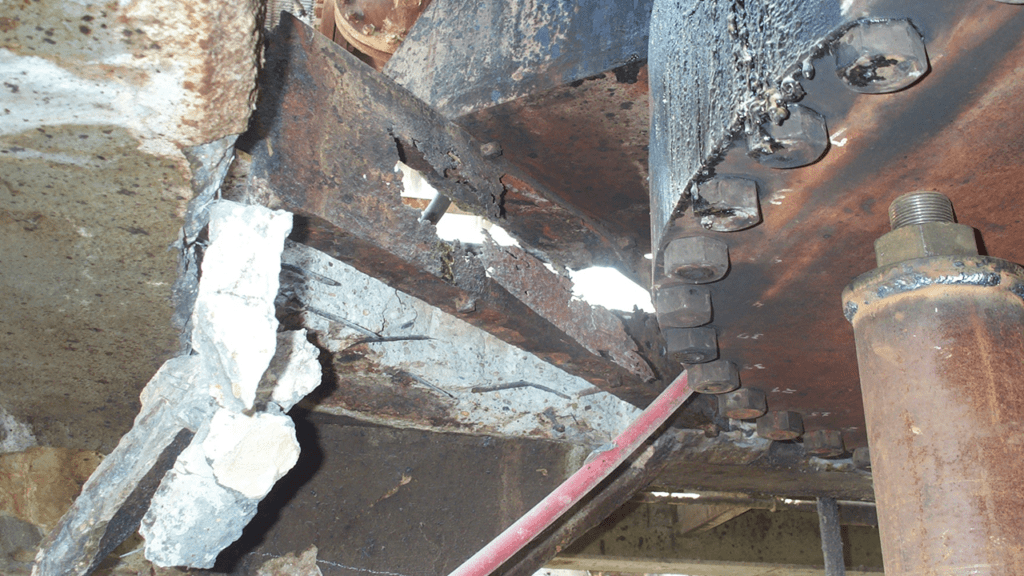
Corrosion under insulation and fireproofing costs building and project owners billions of dollars every year. Many of the factors that cause corrosion, like equipment design, weather, salt spray, humidity and other factors are a challenge — if not impossible — to control. This makes consistent maintenance and frequent inspections not just necessary, but standard.
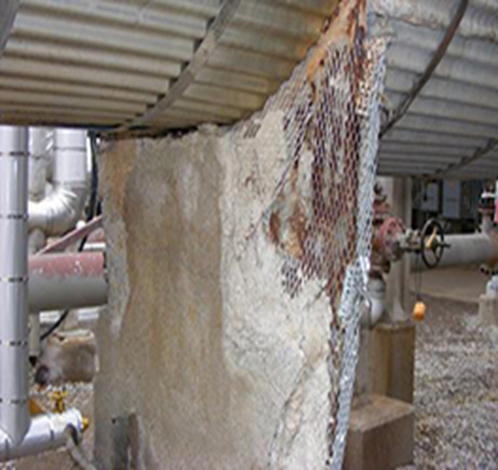
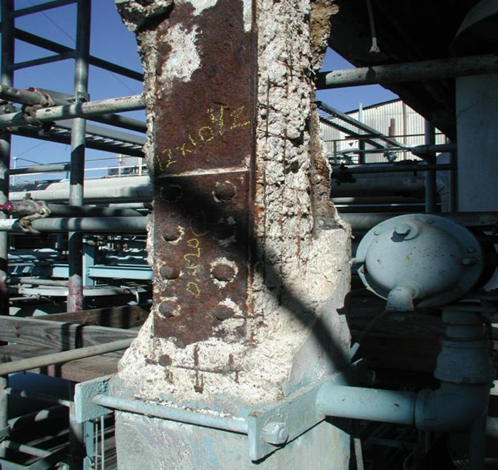
Corrosion under insulation and fireproofing are responsible for many leaks, cracks and other damage including catastrophic structural failure, and there’s pressure in the chemical, manufacturing and refining industries to find effective solutions.
Corrosion under insulation and fireproofing will continue to occur for the foreseeable future, making preventative maintenance and CUI/CUF detection methods of critical importance. Preventing corrosion under insulation and corrosion under fireproofing could save the industry from extra, unnecessary costs and energy expenditure.
Because fireproofing is a necessary part of any industrial productivity to protect workers and the public, measures must be taken to control CUF.
There are a few effective strategies for preventing corrosion under insulation and fireproofing, from the materials selected to the barriers and maintenance systems in place. Many times the means utilized to discover corrosion are not timely and elements must be replaced.
But there are a number of non-invasive methods for inspection, from Eddy Current, radiography to ultrasonic thickness measurements, where sound waves help to capture data from the piping design. This data helps engineers determine instances of CUI and CUF in structural elements, and piping and vessels so that the damage can be addressed.
Expedient discovery is an important part of the strategy. When corrosion begins, the damage is most times exponential with time.
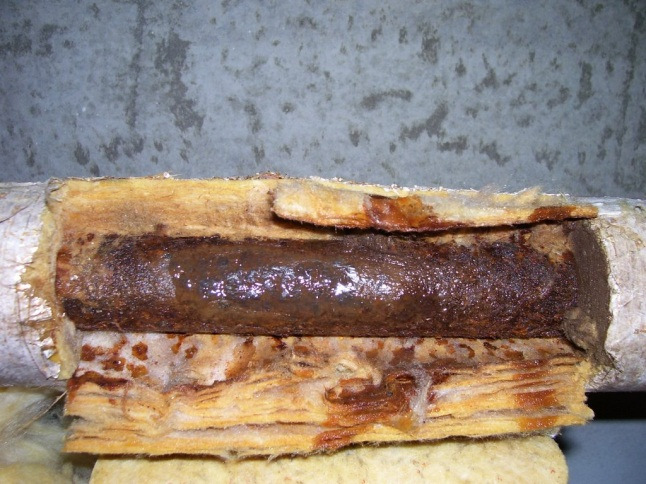
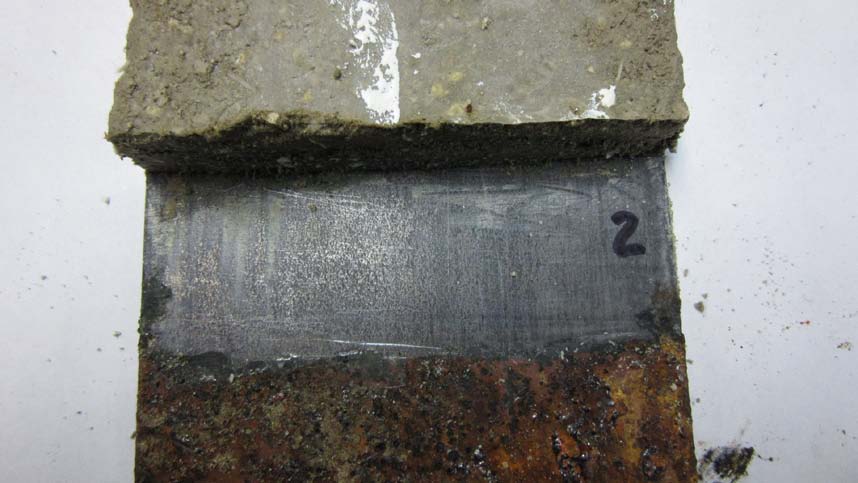
Corrosion under insulation and fireproofing has been a long-standing issue for engineers. “CUI is difficult to find because of the insulation cover that masks the corrosion problem until it is too late,” wrote Michael Twomey for Inspectioneering. “It is expensive to remove the insulation.” Fireproofing is no different.
But engineers and builders have solutions for corrosion under insulation and fireproofing by using the right forms of prevention. Maintenance and inspections are a standard part of every job site, but using an effective corrosion inhibitor is the best way to prevent damage and costly repairs.
The corrosion inhibitor materials from Geopolymer Solutions have helped engineers everywhere address the demands (and cost) of better structural element, piping and vessel protection. Geopolymer Solutions’ Cold Fusion Concrete/cement’s glassy characteristic electrically insulates the substrate and doesn’t allow water or chemicals to contact steel features, eliminating the possibility of corrosion before it begins.
Your project will likely require some sort of fireproofing to protect workers and reduce economic loss during explosions or fire events. Using an economical and environmentally superior fireproofing that inhibits corrosion at the same time makes perfect sense.
The vast majority of clients are return customers, and working with Geopolymer Solutions includes comprehensive training prior to using their products.
The best way to prevent damage is by inhibiting it completely. If you’d like to find out more about Geopolymer Solutions and the high-performance products available, reach out to an expert here.
However, there’s another approach to prevention: using a corrosion inhibitor. When applied, a high-quality corrosion inhibitor product provides excellent protection and damage resistance to structural elements, industrial piping and vessels.
Modern manufacturers have produced a cold fusion concrete that contains an alkali-activator largely comprised of glassy elements, resulting in a product that prevents damage like other materials can’t. The mixture contains no Portland cement, making it far more environmentally palatable to produce, and the product contains none of the inherent weaknesses of Portland.
Using an alkali-activated cement solution gives engineers more options for corrosion protection, as it’s easily produced by combining materials that are accessible throughout the world.
The inherent concrete corrosion inhibitor has been proven to prevent rusting and damage on metal substrates, even after being tested with ten thousand hours of salt spray exposure (ASTM B117). Third-party test report results indicate that using this glassy corrosion inhibitor has a higher resistance to acids, solvents, sulfates and fire than other treatments.
Office Address: 11200 Cox Road Suite B, Conroe, Texas 77385, USA
Email Address: info@geopolymertech.com
Phone Number: 281-419-1866
Follow us on LinkedIn for news & industry insights.
 English
  Spanish
  Dutch
Dutch  French